



Why Does Skin Age?
Understanding what changes beneath the surface—and why healthyskin ageing begins long before the first wrinkle appears.
Editor’s Note
This article is part of the POLARE Skin Longevity Journal, an editorial series exploring the science of healthy skin ageing through evidence-based insights and a long-term perspective.
Why skin ageing begins beneath the surface
When we think about skin ageing, wrinkles are often the first thing that comes to mind.Yet wrinkles are only one visible sign of a much deeper process. Long before the first wrinkle appears, the skin is already changing. It renews itself more slowly, becomes less able to retain moisture and gradually loses some of the structural support that helps keep it firm and resilient. Skin ageing, therefore, is not simply about the passage of time. It is about the gradual evolution of how the skin functions. Understanding these changes also changes how we think about skincare—not as a way to erase visible signs of ageing, but as a way to help skin remain healthier for longer.
The Science Behind Skin Ageing
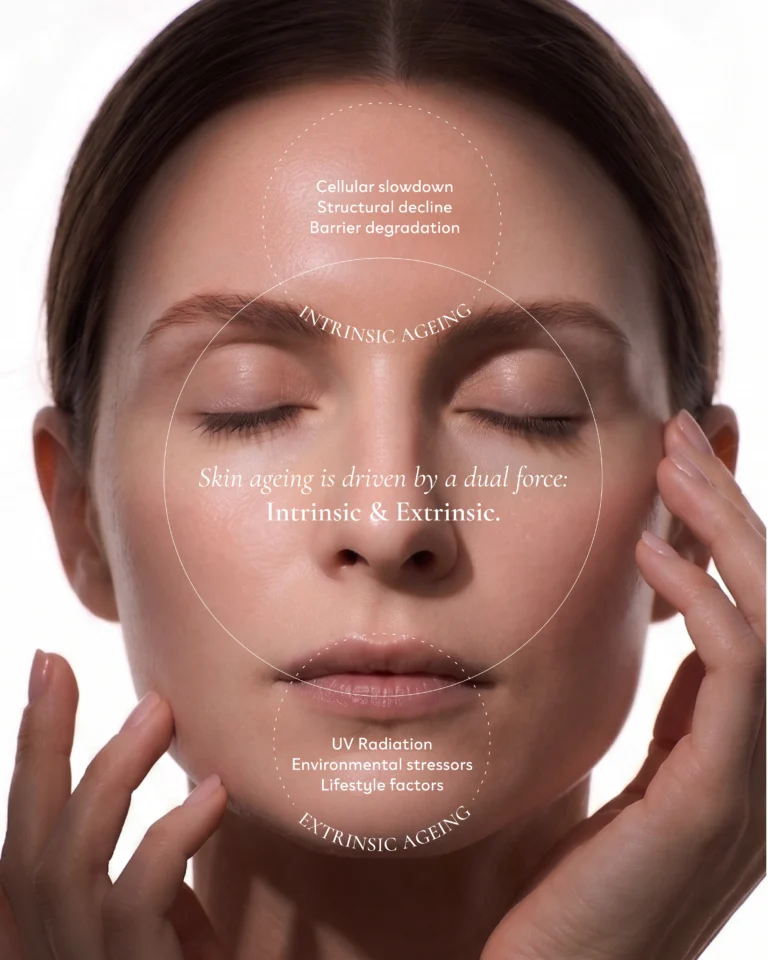
Skin ageing is shaped by two complementary processes.
The first is intrinsic ageing—the natural biological changes that occur throughout life.
The second is extrinsic ageing, influenced by environmental and lifestyle factors such as
ultraviolet (UV) exposure, pollution and smoking.
These two processes work together throughout life.
This is why two people of the same chronological age may experience very different
changes in their skin.
While intrinsic ageing is inevitable, many aspects of extrinsic ageing can be influenced
through everyday habits and long-term skin protection.
What Changes Beneath the Surface?
Skin does not age because of one isolated event.
It changes because multiple biological systems gradually become less efficient over time.
1. The skin’s support network changes
Collagen and elastin form much of the skin’s structural framework.
As skin matures, the production, organisation and renewal of these proteins gradually
change. Over time, this contributes to visible changes in firmness, elasticity and skin density.
2. The skin loses some of its resilience
Healthy skin depends on more than structural proteins.
Its ability to retain moisture, maintain a healthy barrier and respond to environmental stress
also changes with age.
As a result, mature skin may become drier, more sensitive and slower to recover.
3. Skin renewal slows
Healthy skin is constantly renewing itself.
As this natural renewal process becomes less efficient, skin may appear duller, less even
and less radiant.
Taken together, these changes remind us of one important principle:
Skin ageing is not simply a wrinkle problem—it is a gradual change in skin function.
The POLARE Perspective
For decades, anti-ageing skincare has focused primarily on correcting what we can already
see.
At POLARE, we believe another question deserves equal attention:
How can we help skin continue to function at its best as it ages?
This question lies at the heart of our Skin Longevity philosophy.
Rather than focusing on one wrinkle, one ingredient or one moment in time, Skin Longevity
views the skin as a living, interconnected system—where structure, hydration, protection and
renewal work together to support long-term skin quality.
Healthy skin is not defined by the absence of change.
It is defined by its ability to continue functioning well over time.
Key Takeaways
● Skin ageing begins before the first visible wrinkle appears.
● Both intrinsic and extrinsic factors influence how skin ages.
● Healthy skin depends on multiple biological systems working together—not on a single ingredient.
● Long-term skin health is built through protection, resilience and consistency.
Frequently Asked Questions
There is no single age at which skin ageing begins. Biological changes occur gradually, while visible signs vary according to genetics, environmental exposure and lifestyle.
No. Skin ageing results from both intrinsic biological changes and extrinsic factors such as UV exposure, pollution and smoking. These influences work together throughout life.
Premature visible skin ageing is primarily associated with external factors such as UV exposure, pollution and smoking. Many of these influences can be reduced through daily photoprotection and healthy lifestyle habits.
Skincare cannot prevent biological ageing. However, appropriate photoprotection and well-formulated skincare can help support hydration, barrier function and overall skin quality.
Age-related changes in collagen, elastin and the extracellular matrix gradually affect the skin’s structural support, contributing to reduced firmness and elasticity.
At POLARE, Skin Longevity is a long-term approach to skincare that focuses on maintaining the skin’s quality, resilience and function—not simply correcting visible signs of ageing.
Scientific References
The concepts discussed in this article are informed by peer-reviewed research on intrinsic and extrinsic skin ageing, photoageing, extracellular matrix biology, skin barrier function and photoprotection